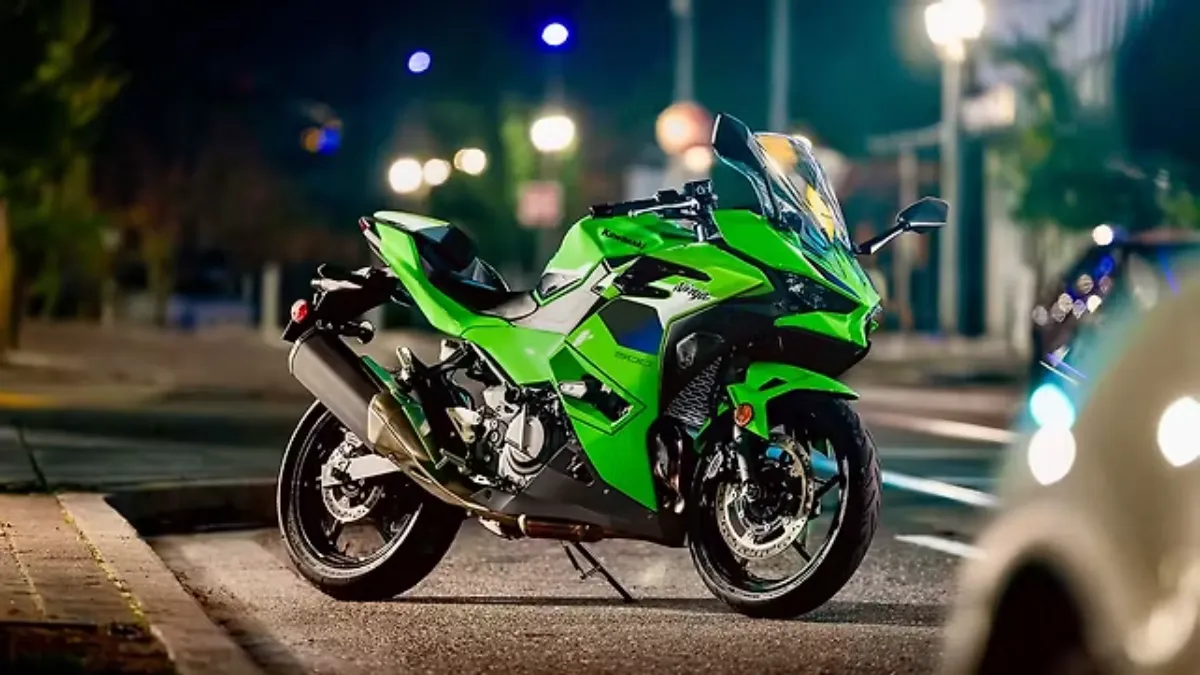
The 2027 Kawasaki Ninja 500 has arrived in India, but this is one of those model-year updates where the story is more about a fresh colour than a mechanical overhaul.
Kawasaki India has listed the 2027 Ninja 500 at ₹5.76 lakh ex-showroom, with the motorcycle available in Lime Green. The 451cc parallel-twin engine, six-speed gearbox and core chassis package continue unchanged.
For buyers searching for a middleweight fully faired motorcycle, however, the Ninja 500 remains an interesting proposition because it combines a relatively friendly riding position with a twin-cylinder engine and Kawasaki’s unmistakable Ninja styling.
2027 Kawasaki Ninja 500: Quick Highlights
| Feature | Details |
|---|---|
| Model | Kawasaki Ninja 500 2027 |
| India Price | ₹5.76 lakh ex-showroom |
| Variant | Standard |
| Colour | Lime Green |
| Engine | 451cc parallel-twin |
| Maximum Power | 45 PS @ 9,000 rpm |
| Maximum Torque | 42.6 Nm @ 6,000 rpm |
| Gearbox | 6-speed |
| Fuel Capacity | 14 litres |
| Seat Height | 785 mm |
| Kerb Mass | 176 kg |
| Front Tyre | 110/70 R17 |
| Rear Tyre | 150/60 R17 |
| Front Brake | Single disc |
| Rear Brake | Single disc |
| ABS | Standard |
| Frame | High-tensile steel trellis |
Kawasaki’s official 2027 India specification page lists these core specifications.
2027 Kawasaki Ninja 500 India Price
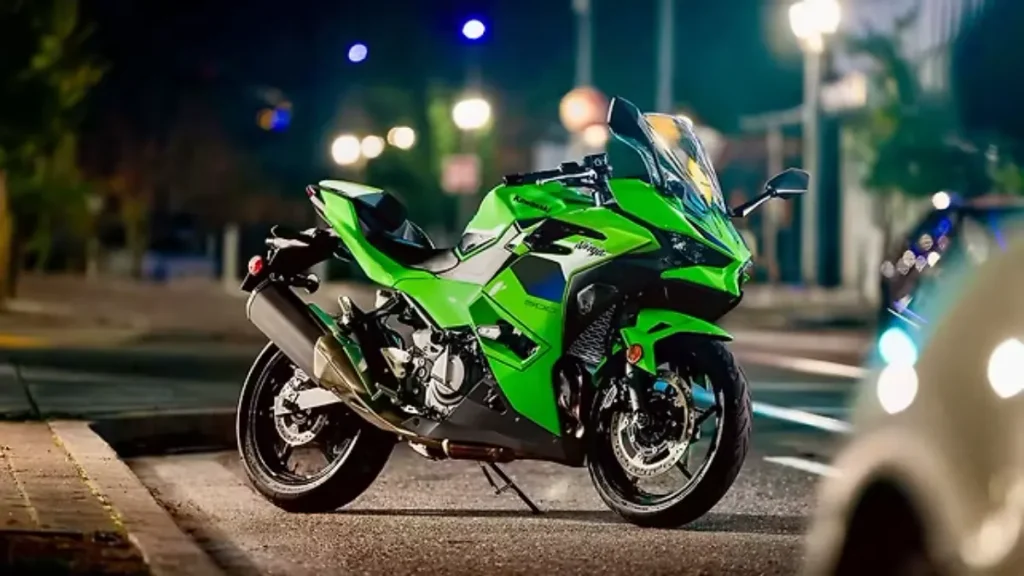
The 2027 Kawasaki Ninja 500 India price is ₹5,76,000 ex-showroom.
Kawasaki India currently lists the motorcycle in a single Standard edition and shows Lime Green as the available colour.
The price is notable because it remains at the same level as the 2026 model. Recent reports confirm that Kawasaki has not increased the price for the new model year.
That means buyers aren’t paying more for the 2027 badge, although they aren’t getting a major mechanical upgrade either.
What Is New for 2027?
The answer is surprisingly simple.
The biggest change is the Lime Green paint scheme.
Recent launch coverage reports that the Indian-spec 2027 Ninja 500 remains mechanically and visually unchanged apart from the new model-year colour treatment.
The familiar Ninja bodywork remains, including its compact front section, twin-headlamp design, flowing fairing and sharp tail.
For Kawasaki fans, this isn’t necessarily a bad thing. The current Ninja 500 already has a modern design, so keeping the styling consistent allows Kawasaki to focus on its established formula rather than changing something that already works.
Lime Green Gives the Ninja a Classic Kawasaki Look
The new Lime Green finish is easily the most noticeable reason to choose the 2027 model.
Kawasaki’s bright green colour has become strongly associated with the brand’s performance motorcycles, and the Ninja 500 gets contrasting graphics that make the fairing stand out.
For someone buying a Ninja primarily for its visual appeal, the colour may actually be enough to make the 2027 version more desirable than an older model.
451cc Parallel-Twin Engine
Underneath the fairing, the Ninja 500 continues with Kawasaki’s 451cc liquid-cooled parallel-twin engine.
It produces:
45 PS at 9,000 rpm

and
42.6 Nm at 6,000 rpm.
The engine uses DOHC and four valves, with fuel injection and a six-speed transmission.
The important thing about this engine isn’t just its peak numbers.
Kawasaki describes the engine as rider-friendly, with useful power across the rev range. That makes the motorcycle suitable for a mixture of city riding and highway use rather than restricting it to occasional spirited rides.
How Does the Ninja 500 Engine Feel?
A parallel-twin engine has a different character from the single-cylinder motors commonly found in smaller motorcycles.
The Ninja 500 is expected to feel:
- Smooth at cruising speeds
- Stronger through the mid-range
- More refined at highway speeds
- More relaxed than a small-capacity single
- Engaging when the engine is revved harder
Kawasaki itself says the engine provides low-end acceleration for city riding while also offering enough top-end performance for highway use.
That broad usability is an important part of the Ninja 500’s appeal.
Six-Speed Gearbox
The 451cc engine is paired with a six-speed transmission.
Having six gears allows the rider to keep the engine in a useful part of its rev range depending on speed.
Lower gears help with acceleration, while the taller upper gears can make highway cruising more relaxed.
The bike also gets Kawasaki’s Assist & Slipper Clutch. The assist function helps reduce clutch lever effort, while the slipper mechanism is designed to reduce rear-wheel hopping during aggressive downshifts.
Lightweight Trellis Frame
One of the defining mechanical features of the Ninja 500 is its high-tensile steel trellis frame.
Kawasaki says its dynamic rigidity analysis was used to balance rigidity and weight, with the engine rigidly mounted as a stressed member.
For riders, the important part is how that translates to the road.
Kawasaki has designed the chassis around light and predictable handling, and the compact dimensions are also intended to make parking and low-speed manoeuvring easier.
Ninja 500 Handling
The Ninja 500 uses a supersport-style chassis philosophy with a relatively short wheelbase and long swingarm.

Kawasaki says the resulting geometry delivers light, natural handling and predictable behaviour.
That makes the motorcycle interesting for riders who want the appearance of a full-sized sportbike without an intimidating riding experience.
It should also make the bike easier to manage when moving through traffic or making tight turns.
785mm Seat Height
The 2027 Kawasaki Ninja 500 seat height is 785mm.
For a fully faired middleweight motorcycle, that is a relatively approachable figure.
Kawasaki has also shaped the seat and rear section of the engine to give riders an unobstructed path for their feet to reach the ground.
That can be particularly useful for riders who are upgrading from smaller motorcycles.
14-Litre Fuel Tank
The motorcycle gets a 14-litre fuel tank.
Kawasaki lists fuel consumption at 3.8 litres per 100km under its stated test conditions.
That works out to roughly 26.3 km/l on the same test basis.
Real-world consumption will vary depending on traffic, speed, riding style, passenger load and road conditions, so this should not be treated as a guaranteed mileage figure.
Still, combined with the 14-litre tank, the Ninja 500 should offer a useful cruising range for a middleweight motorcycle.
310mm Front Brake Disc
The Ninja 500 gets a 310mm semi-floating front brake disc.
Kawasaki points out that the disc is the same diameter as the unit used on the Ninja ZX-6R.
The rear also uses a disc brake, and ABS is included on the Indian model.
That gives the motorcycle a braking package appropriate for its performance level.
17-Inch Wheels and Sportbike Tyres
The Ninja 500 rides on 17-inch wheels with:
Front: 110/70 R17
Rear: 150/60 R17.
These sizes are common for performance-oriented motorcycles and provide a good balance between steering response and stability.
The larger rear tyre also contributes to the bike’s planted appearance.
Full-Fairing Ninja Design
The Ninja name has always been about appearance as much as performance.
The 2027 model continues with Kawasaki’s sharp full-fairing design.
At the front, the bike gets compact twin headlights, while the fairing uses flowing, layered surfaces to create a sporty appearance. Kawasaki says the styling is designed to give the motorcycle the look of a larger Ninja.
This means the Ninja 500 can look considerably more expensive and more powerful than its 451cc displacement might suggest.
Smartphone Connectivity
The standard Ninja 500 uses a high-contrast LCD instrument panel, but Kawasaki’s technology package includes smartphone connectivity through its RIDEOLOGY app.
Depending on supported functions, riders can access information such as:
- Vehicle information
- Odometer
- Fuel level
- Maintenance information
- Riding logs
- Phone notifications
Kawasaki explains that connectivity allows riders to view vehicle information and riding logs through the smartphone application.
Everyday Riding Comfort
One thing that separates the Ninja 500 from more extreme supersport motorcycles is its riding position.
Kawasaki describes the rider triangle as relatively relaxed, with an elevated handlebar position and slightly forward footpegs intended to provide a balance between control and comfort.
The seat also has thick cushioning, while the larger fairing provides wind protection.
So while this is undoubtedly a sportbike, it isn’t designed to punish the rider during every longer ride.
Is the Ninja 500 Good for Daily Use?
It can be.
The motorcycle has several characteristics that help daily usability:
- 785mm seat height
- Smooth twin-cylinder engine
- Relatively predictable handling
- Comfortable riding position
- Six-speed gearbox
- Assist & Slipper Clutch
- 14-litre tank
- Smartphone connectivity
Kawasaki itself describes the Ninja 500 as suitable for a wide variety of riding situations, including everyday riding.
Of course, a fully faired motorcycle will still be less convenient in a crowded city than a lightweight naked bike or scooter.

2027 Kawasaki Ninja 500 vs Aprilia RS 457
The Aprilia RS 457 is one of the most obvious competitors for the Ninja 500 in India.
The Yamaha R2 is another newer motorcycle competing in this broad space, although it is smaller in engine capacity.
The Ninja 500’s main strengths include:
- Parallel-twin engine
- Mature Ninja styling
- Comfortable ergonomics
- Strong mid-range performance
- Kawasaki brand appeal
The Aprilia, meanwhile, offers a modern lightweight sportbike package and strong equipment.
For buyers, the final decision should come down to engine character, weight, riding position, pricing and preferred brand experience.
What Hasn’t Changed for 2027?
This is actually an important part of the story.
The 2027 Ninja 500 does not bring a new engine or major chassis redesign.
Recent launch reports say the mechanical package remains unchanged, including the 451cc engine, six-speed gearbox and existing hardware.
So this is best viewed as a new model-year colour update, rather than a ground-up update.
That’s useful information for buyers because someone shopping for a 2026 Ninja 500 doesn’t necessarily need to upgrade solely because the year number has changed.
2027 Kawasaki Ninja 500: Pros and Cons
Pros
- Strong 451cc parallel-twin engine
- 45 PS and 42.6 Nm
- Six-speed gearbox
- Assist & Slipper Clutch
- Distinctive Ninja design
- 785mm seat height
- Predictable handling
- 310mm front disc
- Dual-channel ABS
- Smartphone connectivity
- New Lime Green colour
Cons
- No major mechanical changes for 2027
- Price remains high for the segment
- LCD display feels less premium than some newer rivals’ TFT units
- Full-fairing design may be less convenient in dense city traffic
Is the 2027 Ninja 500 Worth Buying?
The answer depends on what you’re looking for.
If you want the latest Kawasaki model year and love the Lime Green finish, the 2027 Ninja 500 is an easy choice.
But if you’re deciding between a discounted 2026 model and the 2027 version, the difference is much smaller. Since the mechanical package and price remain unchanged, a lower-priced 2026 motorcycle could potentially offer better value.
That is something buyers should definitely ask their local Kawasaki dealer about.
Final Verdict
The 2027 Kawasaki Ninja 500 India price of ₹5.76 lakh puts the motorcycle firmly into the premium middleweight sportbike category.
The good news is that the Ninja 500 itself remains a strong package. You get a 451cc parallel-twin engine producing 45 PS and 42.6 Nm, a six-speed gearbox, Assist & Slipper Clutch, trellis frame, 785mm seat height, 310mm front disc, ABS and smartphone connectivity.
The catch is that 2027 doesn’t bring a major mechanical upgrade. The new Lime Green finish is the main model-year change, while the engine, chassis and price remain effectively the same.
For someone buying their first middleweight Ninja, that isn’t necessarily a problem. The existing formula is still attractive: big-bike styling, smooth twin-cylinder performance and relatively friendly ergonomics.
For existing 2026 owners, however, there is little technical reason to change bikes simply for the new model year.
In short, the 2027 Ninja 500 is more of a fresh-colour update than a major new-generation motorcycle—and the fact that Kawasaki has kept the price at ₹5.76 lakh makes the buying decision more about the bike itself than the new model-year badge.