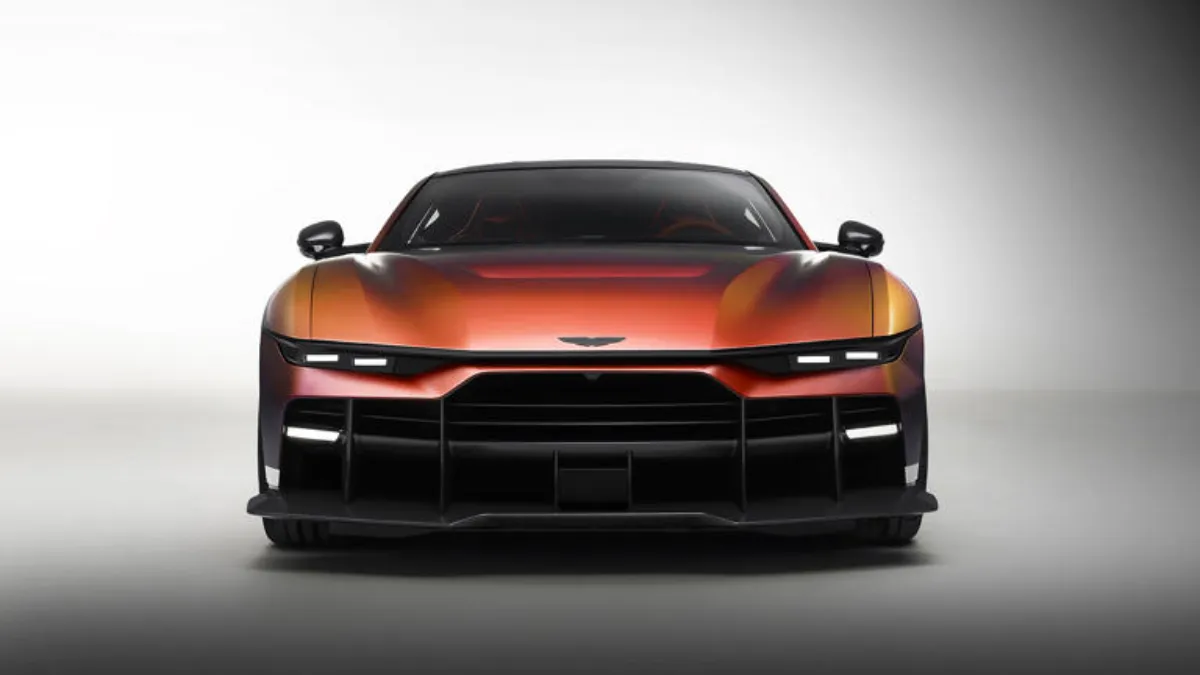
Aston Martin has introduced an extraordinary new limited-production supercar, the Aston Martin Valen, developed by the brand’s bespoke Q by Aston Martin division. Revealed in Monterey, California, the Valen takes the company’s front-engined V12 formula to an entirely new level with a huge 850bhp and 1,000Nm of torque.
The new Valen is being positioned as the world’s most powerful front-engined production car and the most powerful front-engined Aston Martin ever produced. Along with its enormous engine output, the car combines extensive carbon-fibre construction, motorsport-inspired chassis technology and an aggressive aerodynamic design.
Only 150 examples will be produced worldwide, making the Valen an exceptionally rare addition to Aston Martin’s growing collection of high-performance cars.
Aston Martin Valen Engine and Performance
At the heart of the Valen is a 5.2-litre twin-turbocharged V12 petrol engine.
The headline figures are impressive:
| Specification | Aston Martin Valen |
|---|---|
| Engine | 5.2-litre twin-turbo V12 |
| Maximum Power | 850bhp |
| Maximum Torque | 1,000Nm |
| Gearbox | 8-speed ZF automatic |
| 0-100km/h | 3.0 seconds |
| Top Speed | 344km/h (214mph) |
| Production | 150 units worldwide |
The engine produces its maximum 1,000Nm of torque from 2,500rpm, giving the Valen tremendous acceleration potential across the rev range.
Power is sent through an eight-speed ZF automatic transmission. Aston Martin has revised the gearbox software and shift strategies, with some of the calibration influenced by the company’s experience with the Vantage GT4 racing programme.
The result is a supercar designed to deliver not only straight-line speed but also a much sharper driving experience.
0-100km/h in Just 3 Seconds
Despite its large front-mounted V12 engine, the Valen can accelerate from 0 to 100km/h in approximately 3.0 seconds.
Its electronically limited top speed stands at 344km/h (214mph), placing it firmly among the world’s fastest road-going production cars.
But Aston Martin has not focused solely on maximum speed. The company has worked extensively on reducing weight and improving the car’s response, handling and aerodynamic efficiency.
Lightweight Construction Is a Major Focus
One of the biggest engineering changes comes from the Valen’s construction.
Aston Martin says the car can weigh up to 110kg less than its existing core V12 platform. Engineers achieved this through extensive use of lightweight materials, including:
- Carbon fibre
- Aluminium
- Titanium
- Magnesium
The Valen also comes with lightweight magnesium wheels as standard.
For buyers seeking even lower weight, an optional lightweight package adds machined aluminium suspension components and titanium chassis bolts. This package reduces weight by another 16.9kg.
That weight-saving approach should make the Valen feel considerably more agile than a conventional large-engined GT.

Revised Suspension and Chassis Setup
Aston Martin has made significant changes to the chassis rather than simply increasing engine power.
The Valen features model-specific springs, helper springs and Bilstein DTX semi-active dampers. The rear subframe is also solid-mounted to improve the connection between the car and the road.
The steering, braking and electronic control systems have all been specifically revised.
Drivers can select from three main driving modes:
- Sport
- Sport+
- Track
Each setting changes the car’s throttle response and dynamic behaviour, allowing the Valen to move from a high-performance road car toward a much more focused track-oriented machine.
High-Performance Pirelli Tyres
The Valen rides on specially tuned Pirelli P Zero R tyres, developed to complement its high-performance chassis.
Aston Martin also offers P Zero Winter 2 tyres for customers who require greater versatility in colder conditions.
Another interesting feature is Pirelli’s Cyber Tyre technology. The system provides real-time tyre information to the vehicle’s electronic systems, including stability control, ABS and traction control.
This allows the car’s electronics to better understand tyre behaviour and optimise their intervention.
Carbon-Ceramic Brakes
Stopping an 850bhp V12 supercar requires serious braking hardware.
The Aston Martin Valen uses large carbon-ceramic brakes, measuring:
- 410mm at the front
- 360mm at the rear
Carbon-ceramic brakes offer strong resistance to heat during repeated hard braking, making them particularly useful when the car is driven aggressively on a circuit.
Combined with the revised suspension, steering and electronic systems, the braking package is designed to match the Valen’s enormous performance.
Aston Martin Valen Design: A More Aggressive V12
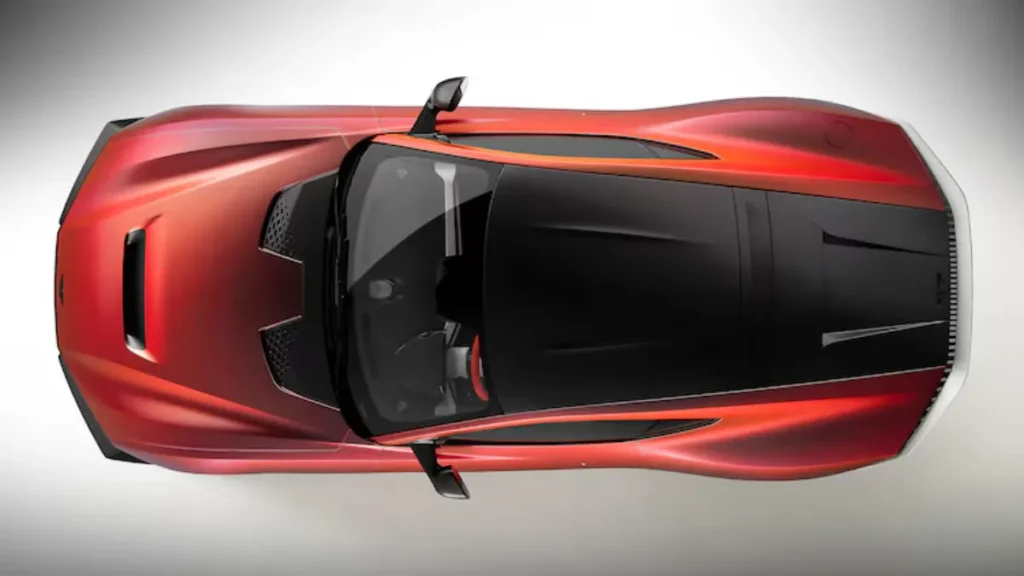
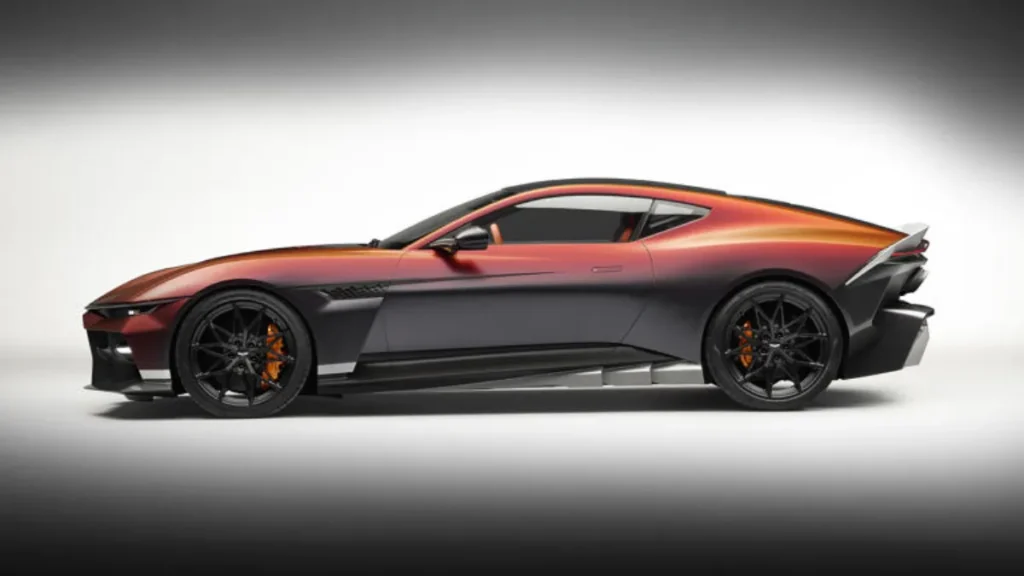
The Valen retains the traditional proportions associated with Aston Martin’s front-engined sports cars, but its design is considerably more aggressive.
Its body is constructed using full carbon fibre, helping reduce weight while allowing designers to create complex aerodynamic surfaces.

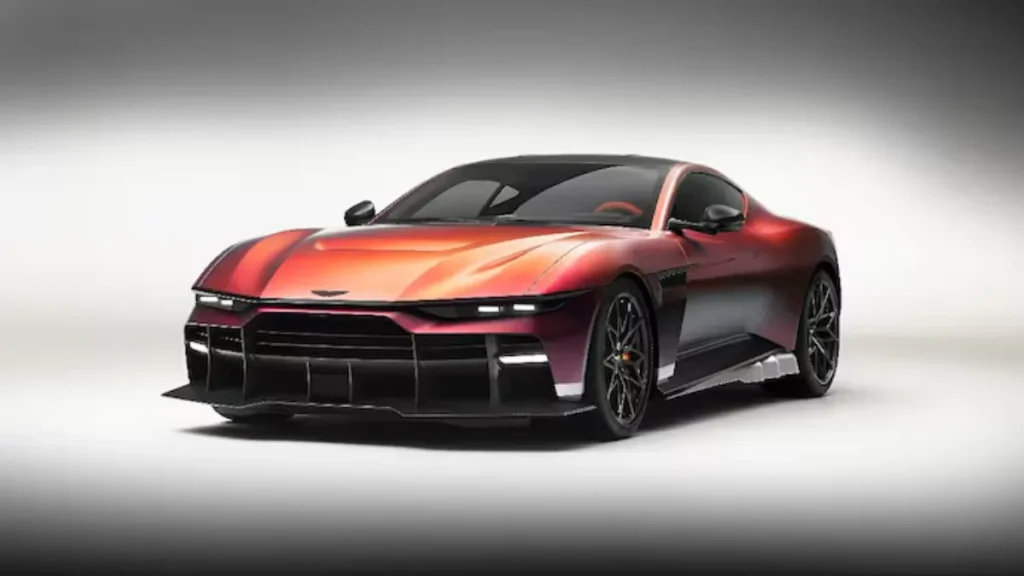
At the front, the Valen features:
- Slim recessed headlamps
- A sharply sculpted bonnet
- A larger geometric grille
- An aggressive front splitter
- Pronounced aerodynamic detailing
The overall appearance is wider, lower and more purposeful than Aston Martin’s conventional V12 models.
Aerodynamics Play a Major Role
The Valen’s bodywork isn’t just about visual drama.
Along the sides, elongated functional vents help manage airflow, while pronounced rear haunches give the car a muscular stance.
The stepped side sills and vortex generators are designed to control airflow around the body and help reduce aerodynamic lift.
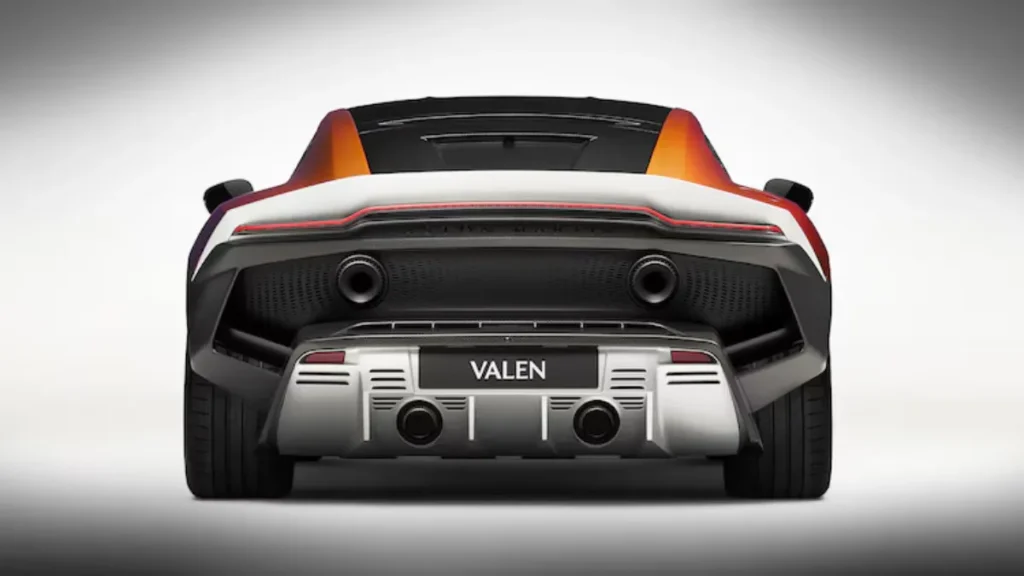
At the rear, Aston Martin has taken a particularly unusual approach.
Instead of a conventional rear window and boot-lid arrangement, the Valen uses a solid tailgate incorporating an aerodynamic wing.
This gives the rear section a distinctive appearance while contributing to the car’s aerodynamic performance.
Four Titanium Exhaust Pipes
One of the Valen’s most striking details is its exhaust arrangement.
The car features four titanium tailpipes, positioned as two upper and two lower outlets.
Aston Martin uses lightweight 3D-printed titanium components and specially developed micro-mufflers as part of the exhaust system.
The arrangement is intended to deliver a distinctive V12 soundtrack while keeping the exhaust hardware as light as possible.
170-Litre Boot
Although the Valen is built primarily around performance, Aston Martin has not completely ignored practicality.
The supercar provides a 170-litre boot.
Customers can also select an optional Touring Pack, which includes a bespoke luggage set designed specifically for the car.

That should make the Valen somewhat more usable for longer journeys than a purely track-focused machine.
Aston Martin Valen Interior
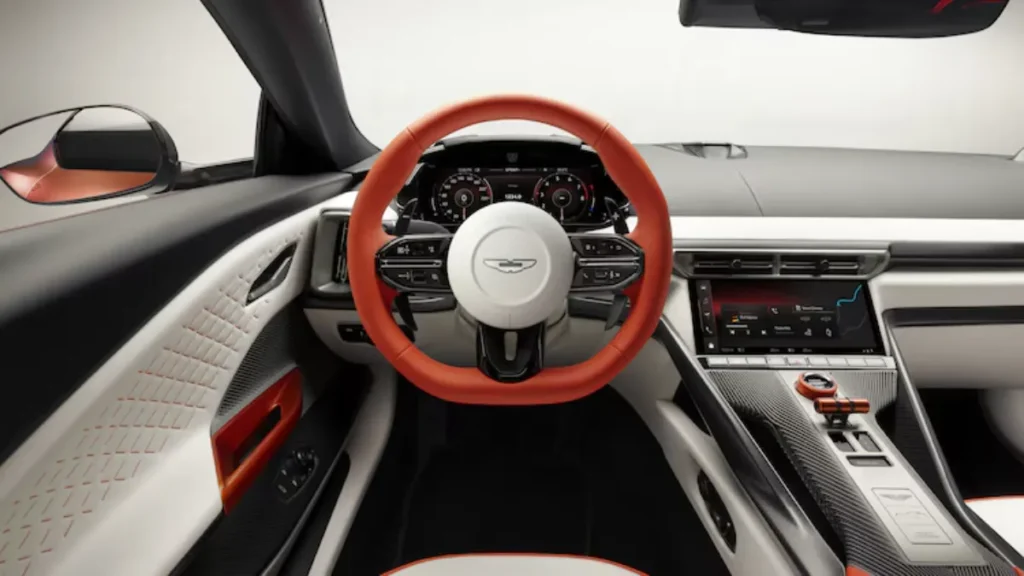
Inside, Aston Martin has created a cabin with a strong focus on the driver.
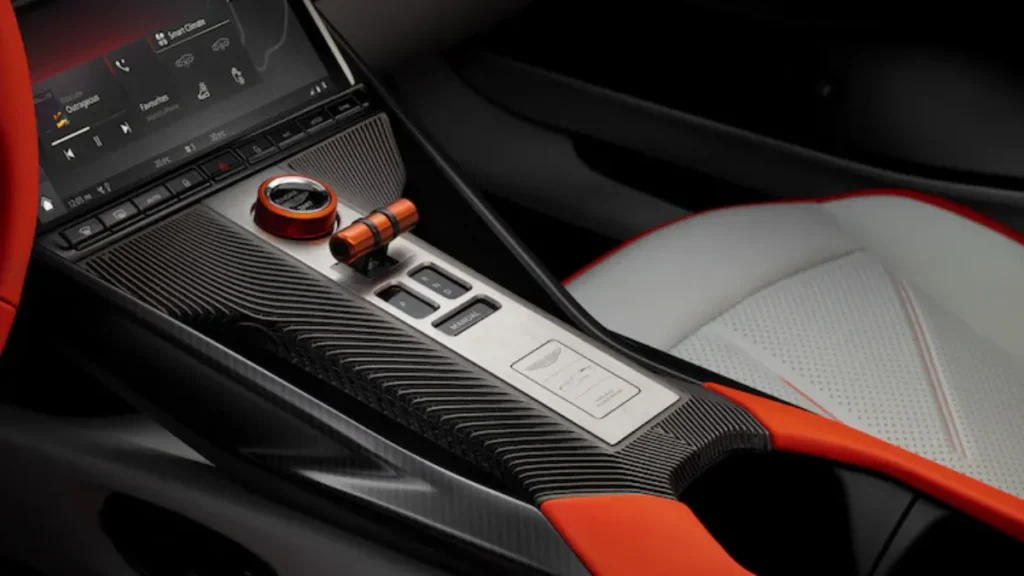
Rather than filling the dashboard with unnecessary visual elements, the Valen uses a cleaner cockpit layout with a slim, angled centre console.
The centre console incorporates 3D-printed components, while the switchgear design takes inspiration from the Aston Martin Valhalla.
The result is intended to provide a more focused and performance-oriented driving environment.
Seat and Interior Options
Buyers can choose between Sports Plus seats and lightweight carbon-fibre performance seats.
Interior upholstery can be specified in combinations of:
- Semi-Aniline leather
- Alcantara
- Full Semi-Aniline leather
There are also numerous trim combinations available.
Because the Valen comes from Aston Martin’s Q by Aston Martin division, customers can take personalisation much further, creating individual specifications that reflect their own tastes.
How Rare Is the Aston Martin Valen?
The Valen is not going to be a high-volume Aston Martin.
The company plans to build just 150 examples worldwide.
That limited production makes the Valen significantly more exclusive than Aston Martin’s regular V12 models and positions it as a collector-focused supercar.
With its bespoke construction, enormous V12 output and extensive Q by Aston Martin personalisation, each example is expected to be a highly individual car.
Aston Martin Valen Delivery Timeline
Aston Martin has scheduled the first customer deliveries for the second quarter of 2027.
With production capped at 150 cars, availability will naturally be extremely limited.

The Valen is therefore aimed at a very small group of collectors and enthusiasts looking for an exclusive front-engined V12 machine rather than a conventional performance car.
Aston Martin Valen vs Regular V12 Aston Martins
The Valen takes the familiar Aston Martin V12 formula and pushes almost every part of it further.
Compared with a conventional V12 Aston Martin, the Valen brings:
- More power
- More torque
- Lower weight
- More aggressive aerodynamics
- Revised suspension
- Motorsport-inspired transmission calibration
- Carbon-ceramic brakes
- Magnesium wheels
- Extensive carbon-fibre bodywork
- Greater Q by Aston Martin personalisation
This combination makes it much more than a simple engine upgrade.
Why the Aston Martin Valen Is Special
The biggest attraction of the Valen isn’t just its 850bhp output.
Its importance comes from the way Aston Martin has combined a traditional front-engined V12 layout with modern lightweight engineering and track-focused technology.
At a time when the supercar industry is rapidly moving toward hybrid and fully electric powertrains, the Valen represents a very different approach.
It celebrates the traditional ingredients of a high-performance Aston Martin: a large-capacity V12, dramatic styling, a long bonnet and a strong focus on driver engagement.
The result is an unusually powerful and exclusive machine that is designed to appeal to collectors who still value the character of a combustion-engine supercar.
Final Verdict
The Aston Martin Valen is shaping up to be one of the most extreme front-engined Aston Martins ever created.
With 850bhp, 1,000Nm, a 5.2-litre twin-turbo V12, a 344km/h top speed and a 3.0-second 0-100km/h time, the numbers alone make it extraordinary. Add lightweight carbon-fibre construction, magnesium wheels, carbon-ceramic brakes, sophisticated suspension and bespoke Q by Aston Martin personalisation, and the Valen becomes something far more special than a conventional V12 grand tourer.
Only 150 examples are planned, with first deliveries expected in Q2 2027. For collectors and serious Aston Martin enthusiasts, the Valen could become one of the marque’s most desirable modern V12 cars.
In short, the Valen is a celebration of Aston Martin’s front-engined V12 heritage—but engineered with the kind of lightweight technology and performance expected from a modern limited-production supercar.