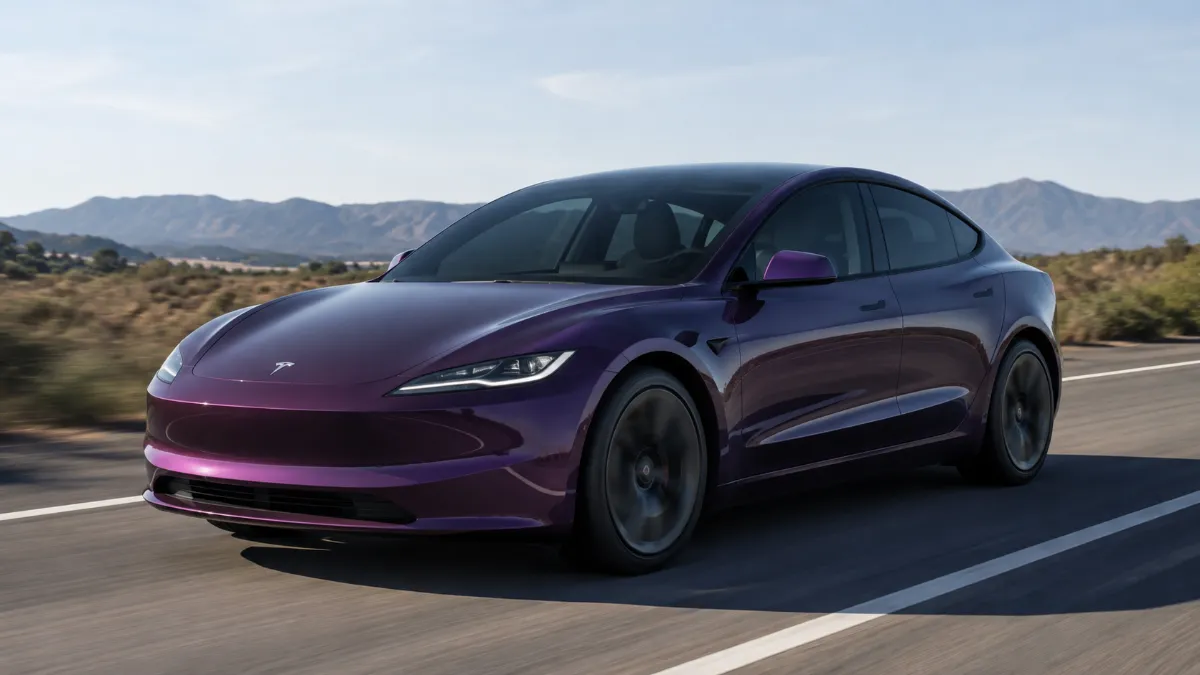
Tesla Autopilot is one of the most talked-about driver-assistance technologies in the automotive industry. Instead of relying on a driver to constantly control every part of a journey, Tesla combines cameras, powerful onboard computing, artificial intelligence and software to assist with steering, acceleration, braking and other driving tasks.
But there is a lot more happening behind the scenes than simply turning on Autopilot and letting the car steer.
Modern Tesla vehicles use a camera-based perception system supported by neural-network software and dedicated computing hardware. Tesla describes its approach as using advanced AI for vision and planning, with neural networks processing information from the vehicle’s cameras to understand the road and surrounding environment.
So, how does it actually work?
Let’s take a closer look at the technology behind Tesla Autopilot, from the cameras mounted around the vehicle to the software that turns visual information into driving decisions.
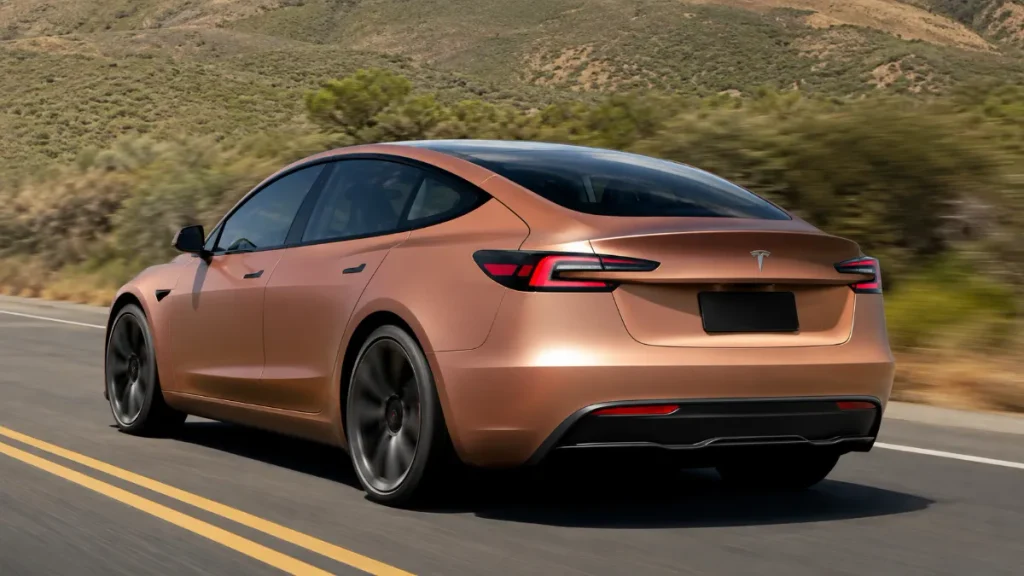
What Is Tesla Autopilot?
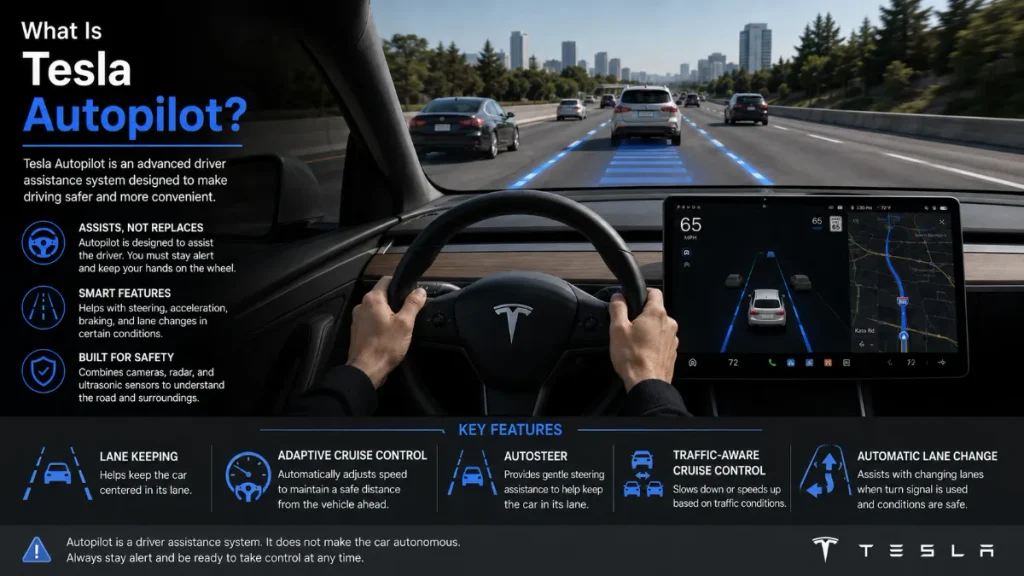
Tesla Autopilot is a collection of advanced driver-assistance features, rather than a fully autonomous driving system.
Its basic capabilities include Traffic-Aware Cruise Control and Autosteer. Traffic-Aware Cruise Control can maintain a selected speed and adjust it according to traffic ahead, while Autosteer assists with steering within its operating conditions.
Depending on the Tesla model, software version, hardware and market, additional features can include:
- Auto Lane Change
- Autopark
- Summon
- Traffic Light and Stop Sign Control
- Navigate on Autopilot
- Full Self-Driving (Supervised)
Not every Tesla has every feature, however. Tesla specifically notes that feature availability can depend on the vehicle configuration, hardware, software version, region, model, trim and model year.
The Camera System: Tesla’s Eyes on the Road
One of the most important parts of Tesla’s driver-assistance technology is its network of exterior cameras.
Modern Tesla vehicles use cameras positioned around the vehicle to provide a broad view of the surrounding environment. Tesla’s current FSD information describes eight external cameras providing 360-degree visibility on supported vehicles.
These cameras can observe areas such as:
- The road ahead
- Vehicles in adjacent lanes
- The rear of the vehicle
- Blind-spot areas
- Lane markings
- Traffic signs and signals
- Pedestrians and cyclists
- Other objects around the vehicle
Tesla’s software then combines information from these cameras to create an understanding of what is happening around the vehicle.
The important point is that the cameras aren’t simply recording video like a dashcam. Their images become inputs for Tesla’s neural-network systems.
How Tesla Vision Works
Tesla has increasingly built its driver-assistance approach around Tesla Vision, which uses cameras and neural-network processing to understand the driving environment.
Tesla says Model 3 and Model Y vehicles produced from April 2022, along with certain Cybertruck vehicles for specific markets, use Tesla Vision for Autopilot and related features.
Instead of depending primarily on a traditional radar-based perception system, the vehicle’s cameras provide visual information that software processes in real time.
This is similar to how humans drive in one important respect: the vehicle receives visual information and attempts to understand what it means.
Of course, a computer doesn’t “see” the road in exactly the same way a human does.
It analyzes pixels, patterns, movement and other information to estimate what objects are present and how the road is structured.
Tesla’s Neural Networks: The Software Brain
The cameras are only the beginning.
The real intelligence comes from the software processing their data.
Tesla says its per-camera neural networks analyze raw images for tasks including semantic segmentation, object detection and monocular depth estimation. Tesla also describes birds-eye-view networks that combine video from multiple cameras to produce information about road layout, static infrastructure and 3D objects.
In simple terms, the system is trying to answer questions such as:
Where is the road?
Where are the lane lines?
What is that object?
How far away is it?
Is it moving?
What is likely to happen next?
The software then uses this understanding to help determine an appropriate driving action.
From Camera Images to a Driving Decision
Imagine a Tesla approaching a slower vehicle on a highway.
The process may look simple from inside the cabin, but there are several layers of computation happening behind the scenes.
Step 1: Cameras Capture the Environment
The vehicle’s external cameras continuously observe the road and surrounding area.
Step 2: Neural Networks Analyze the Images
Software identifies visual features such as lane markings, vehicles, road edges and other objects.
Step 3: The System Builds an Environmental Model
Information from different cameras can be combined to create a broader representation of the vehicle’s surroundings.
Step 4: The System Evaluates the Road
The software considers the vehicle’s position, road layout, nearby traffic and other available information.
Step 5: Driving Actions Are Planned
Depending on the active feature, the system can assist with steering, acceleration, braking or lane changes.
Step 6: The Vehicle Executes the Command
The car’s electronic control systems then carry out the appropriate maneuver.
This entire process happens extremely quickly.
Tesla says its current FSD system processes visual information at very high speed, with its safety page describing more than one million pixels of visual data being processed every millisecond.
What Is the Tesla AI Computer?
Processing camera data and running neural networks requires significant computing power.
That’s where Tesla’s AI computer comes in.
Tesla says its AI computer was designed specifically to rapidly process neural networks and support intelligent vehicle control.
Think of it as the computer hardware responsible for running the software that interprets the vehicle’s sensor and camera information.
The hardware is important because advanced driver assistance requires large amounts of data to be processed quickly.
A system that recognizes a pedestrian, for example, isn’t useful if it takes several seconds to react.
The computer needs to process information continuously and quickly enough for the vehicle to respond appropriately.
Tesla’s FSD Computer and Hardware Generations
Tesla has used different generations of hardware over the years.
This is one reason why you shouldn’t assume that every Tesla has identical self-driving capabilities simply because the cars look similar.
Tesla’s support documentation explains that older vehicles can have different generations of self-driving hardware, and owners can check their AI computer information through the vehicle’s touchscreen.
Tesla has also offered hardware upgrades for certain eligible vehicles.
The exact capabilities depend on the specific vehicle, so owners should check:
Controls → Software → Additional Vehicle Information
The menu and terminology can vary depending on the Tesla model and software version.
Does Tesla Still Use Radar and Ultrasonic Sensors?
This is where Tesla’s hardware story gets interesting.
Tesla has changed its sensor strategy over time.
Some older Tesla vehicles were equipped with combinations of cameras, radar and ultrasonic sensors. Tesla’s own documentation notes that earlier vehicles included radar and ultrasonic sensors, while later Tesla Vision configurations rely heavily on camera-based perception.
This means you should not assume that every Tesla uses exactly the same sensor setup.
A vehicle built several years ago can have substantially different hardware from a newer model.
That distinction matters when discussing Autopilot because software capabilities depend partly on the hardware available to the vehicle.
What About Ultrasonic Sensors?
Ultrasonic sensors were traditionally useful for detecting nearby objects, especially during parking.
They can help determine whether something is very close to the vehicle.
However, Tesla has moved toward camera-based perception in many newer configurations.
The company’s newer Tesla Vision approach is designed to use cameras and neural networks for a broader understanding of the environment.
Again, exact hardware varies by model and production period.
The Cabin Camera: Watching the Driver
Tesla’s driver-assistance technology isn’t only watching the road.
Some Tesla vehicles also have a cabin camera positioned inside the vehicle.
Tesla says the cabin camera can monitor driver attentiveness while Autosteer or Full Self-Driving (Supervised) is engaged.
This is an important part of modern driver assistance because the system isn’t designed to operate as an unattended chauffeur.
If the vehicle determines that the driver isn’t responding appropriately to attention prompts, it can issue escalating warnings.
Tesla states that failure to respond can eventually cause Self-Driving features to disengage and become unavailable for the remainder of the drive.
How Autopilot Understands Lane Markings
Lane detection is one of the most fundamental tasks for a system such as Autosteer.
The cameras look for visual information that helps define the driving lane.
Clear lane markings make this easier.
But roads aren’t always perfect.
Construction zones, faded lines, unusual road layouts, poor weather and strong sunlight can make visual interpretation more difficult.
Tesla’s manuals warn that poor visibility, bright light, blocked cameras, sharp curves and other conditions can affect the performance of Self-Driving features.
This explains why Autopilot isn’t equally comfortable in every driving environment.
Camera Calibration Is Important
A camera has to know where it is looking.
If a camera is replaced, serviced or loses its calibration, the vehicle may need to recalibrate before certain driver-assistance features become available.
Tesla explains that some vehicles perform camera calibration by driving under conditions where highly visible lane markings are available.
This is one reason a windshield replacement or camera-related service should not be treated like an ordinary cosmetic repair.
If a camera is positioned incorrectly, the software’s interpretation of the road could be affected.
What Happens When a Camera Is Blocked?
A dirty or obstructed camera can cause problems.
Dust, mud, snow, condensation, stickers and other obstructions can reduce visibility.
Tesla advises owners to keep cameras clean and unobstructed before driving and before using Self-Driving features.
Environmental conditions can also affect camera performance.
Examples include:
- Heavy rain
- Snow
- Fog
- Direct sunlight
- Oncoming headlights
- Poorly lit roads
- Dirty camera surfaces
- Condensation
When camera visibility is inadequate, some driver-assistance features may become unavailable.
Tesla Software Is Constantly Evolving
Another major difference between Tesla and a traditional vehicle is the role of software updates.
Tesla can deliver software updates over the air, meaning the vehicle’s capabilities can change without a conventional dealership visit.
Tesla says its Self-Driving capabilities continue to evolve through over-the-air software updates.
This means the Tesla you buy today may not have exactly the same software experience several months or years later.
However, software updates don’t magically turn every vehicle into the same hardware configuration.
The vehicle’s underlying hardware still matters.
How Full Self-Driving (Supervised) Uses the Technology
Full Self-Driving (Supervised) takes the technology beyond basic highway assistance.
Tesla says the system can perform tasks such as navigating routes, making turns, changing lanes and handling certain intersections and other road situations under active driver supervision.
The system uses onboard cameras and AI processing to understand the environment and determine appropriate actions.
The word “Supervised” is extremely important.
Tesla explicitly says that FSD (Supervised) does not make the vehicle autonomous and requires active driver supervision.
So even when the vehicle is handling a large part of the driving task, the person in the driver’s seat remains responsible.
Why Tesla Uses a Vision-Based Approach
Tesla’s philosophy is heavily centered on visual perception and AI.
The company says it believes advanced AI for vision and planning, supported by efficient inference hardware, is the approach needed for a general solution to Full Self-Driving.
There is a practical reason behind this approach.
Roads are visually complicated.
A camera can capture lane markings, traffic lights, signs, vehicles, pedestrians and the overall structure of the road in a way that provides rich contextual information.
Tesla’s neural networks are then designed to interpret this information.
The goal isn’t simply to detect an object.
The system needs to understand what the object is, where it is, how it is moving and how it relates to the vehicle’s planned path.
The Role of Training Data
AI systems become better by learning from large amounts of data.
Tesla says its FSD technology is trained using anonymous real-world driving data gathered from its fleet. Tesla describes the fleet as a source of diverse driving scenarios used to train and improve its neural networks.
This is important because real roads contain an almost endless variety of situations.
A system might encounter:
- Unusual intersections
- Temporary construction
- Pedestrians crossing unexpectedly
- Motorcycles
- Bicycles
- Emergency vehicles
- Poorly marked lanes
- Strange road geometry
- Different weather conditions
The more varied the training scenarios, the more situations the software can potentially learn to recognize.
Why Tesla’s Approach Is Different From Traditional Cars
A traditional car can certainly have advanced safety systems, but Tesla has built a particularly software-focused approach around its vehicles.
The difference can be summarized like this:
Traditional vehicle: Hardware and software are often relatively fixed after purchase.
Tesla: Hardware provides the foundation, while software updates can continuously change and expand the driving experience.
The Tesla approach also integrates cameras, neural networks, onboard computing and vehicle controls into a single software-driven system.
That’s what makes the technology feel less like a collection of individual safety features and more like a connected driving platform.
What Autopilot Can and Cannot Do
Autopilot can reduce workload, but it has limitations.
It can assist with tasks such as:
- Maintaining speed
- Adjusting speed for traffic
- Steering within a lane
- Supporting certain lane changes
- Parking on supported vehicles
- Performing additional driving tasks with FSD (Supervised)
But it cannot guarantee that an accident will never happen.
Tesla warns that Self-Driving features do not guarantee collision warning or collision avoidance and that drivers must remain attentive and ready to take corrective action.
This is perhaps the most important part of understanding the technology.
Weather Still Matters
Even sophisticated AI cannot completely eliminate the challenges created by poor visibility.
Heavy rain, snow, fog, glare and direct sunlight can interfere with camera visibility.
Tesla specifically lists these conditions among factors that can affect Self-Driving performance.
That’s why drivers should never assume that the system will perform identically in every environment.
If visibility becomes poor, the correct response is to pay even more attention and be prepared to take over.
Can Tesla Autopilot See Everything?
No.
The system has a broad camera view, but that doesn’t mean it has perfect awareness.
Objects can be hidden behind other vehicles.
A camera can be blocked.
Weather can reduce visibility.
Road markings can disappear.
An unusual situation can confuse the system.
Tesla itself warns that driver-assistance and collision-avoidance features can produce inaccurate, unnecessary or missed warnings under certain conditions.
For that reason, the driver remains the final layer of safety.
Tesla Autopilot vs. Fully Autonomous Driving
It is easy to confuse the two.
Autopilot and FSD (Supervised):
- Assist the driver
- Can perform certain driving tasks
- Use cameras and AI
- Require driver attention
- Can require immediate driver intervention
Fully autonomous driving:
- Would operate without an attentive human driver
- Would not require continuous human supervision
Tesla’s current documentation is clear that its currently enabled Self-Driving features do not make Tesla vehicles fully autonomous.
That distinction should always be kept in mind when discussing Tesla technology.
What Makes Tesla Autopilot So Interesting?
The most fascinating part isn’t any single camera or sensor.
It’s the combination.
Cameras provide visual information.
Neural networks interpret that information.
The AI computer processes the models.
Software plans driving actions.
The vehicle’s control systems execute those actions.
The cabin camera can monitor driver attentiveness.
Over-the-air updates can improve the software over time.
Put all of those pieces together and you get a highly integrated driver-assistance platform.
Frequently Asked Questions
How many cameras does a Tesla use for Full Self-Driving?
Tesla’s current FSD safety information describes eight external cameras providing 360-degree visibility on supported vehicles. Exact camera hardware can vary between Tesla models and generations.
Does Tesla Autopilot use radar?
It depends on the Tesla’s hardware generation and configuration. Older Tesla vehicles used radar alongside cameras, while Tesla Vision configurations rely heavily on camera-based perception.
Does Tesla use LiDAR for Autopilot?
Tesla’s current production approach does not rely on LiDAR as the primary perception system for Autopilot/FSD. Tesla emphasizes camera-based vision and neural-network processing.
What is the Tesla AI computer?
It is specialized onboard computing hardware designed to process the neural networks used by Tesla’s driver-assistance and Self-Driving software.
Does FSD (Supervised) make Tesla fully autonomous?
No. Tesla explicitly states that FSD (Supervised) requires active driver supervision and does not make the vehicle autonomous.
Can dirty cameras affect Autopilot?
Yes. Tesla warns that blocked, dirty or blinded cameras can affect Self-Driving performance and may make certain features unavailable.
Does every Tesla have the same Autopilot hardware?
No. Hardware and capabilities vary according to model, production date, configuration, software and region.
Final Verdict
Tesla Autopilot is much more than a cruise-control system with steering assistance.
Behind the familiar Tesla touchscreen is a complex combination of cameras, AI computers, neural networks, software and vehicle-control systems working together to interpret the road and assist the driver.
The cameras provide the vehicle with a view of its surroundings. Neural networks turn raw visual information into an understanding of lanes, objects and road layouts. The AI computer processes those models quickly enough to support real-time driving functions, while software updates allow Tesla to continue improving its capabilities.
But impressive technology doesn’t remove human responsibility.
Tesla Autopilot and FSD (Supervised) are driver-assistance systems, not permission to stop paying attention.
For owners, the best way to use the technology is to understand what the car can do, understand what it cannot do, keep the cameras clean, pay attention to the road and remain ready to take control at any moment.
That balance—advanced technology combined with an alert human driver—is what Tesla’s current driver-assistance system is ultimately designed around.