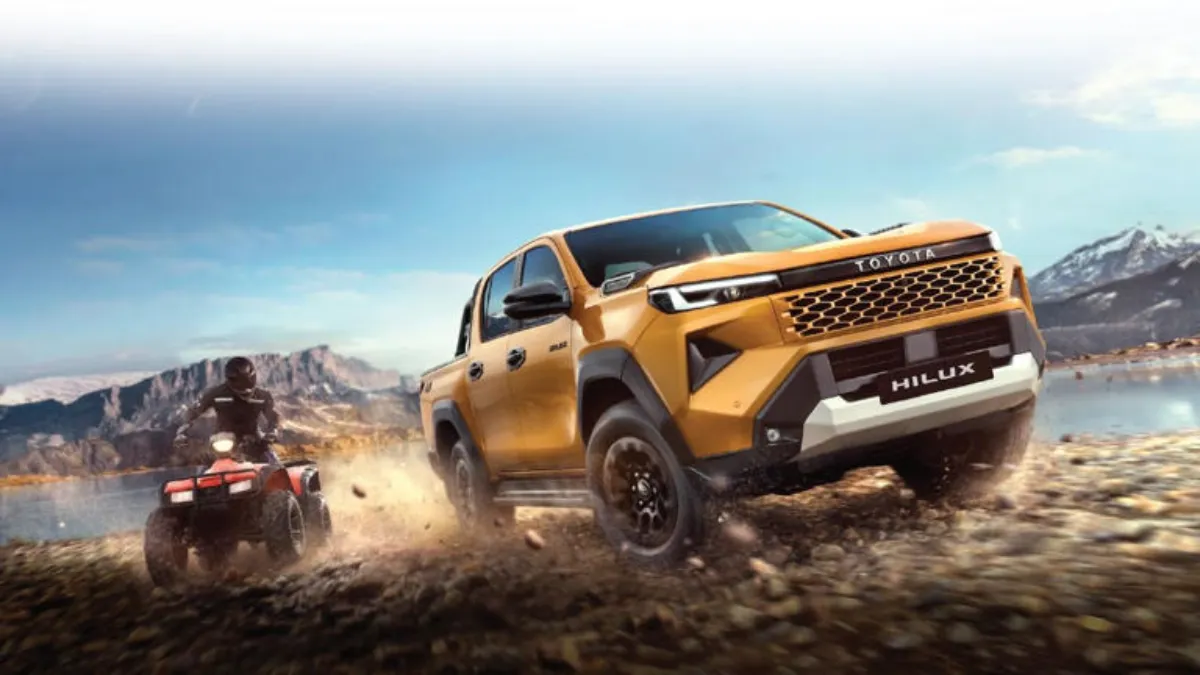
The 2026 Toyota Hilux has arrived in India with a sharper design, a more modern cabin and the familiar 2.8-litre diesel engine. Toyota has also introduced a new 4×2 version alongside the 4×4 variants, giving buyers more choice. The India-spec Hilux starts at ₹31.99 lakh (ex-showroom).
However, the Indian version is not identical to the Hilux sold in some international markets. A closer look at the equipment list reveals several features that global buyers can get but Indian customers currently miss out on.
That does not necessarily make the India-spec Hilux a bad product. In fact, some of these omissions could appeal to buyers who prioritise simplicity and long-term durability. But considering the Hilux’s premium positioning, there are a few features that would certainly have made the package more complete.
Here are six notable features missing from the India-spec 2026 Toyota Hilux.
1. Leatherette Upholstery
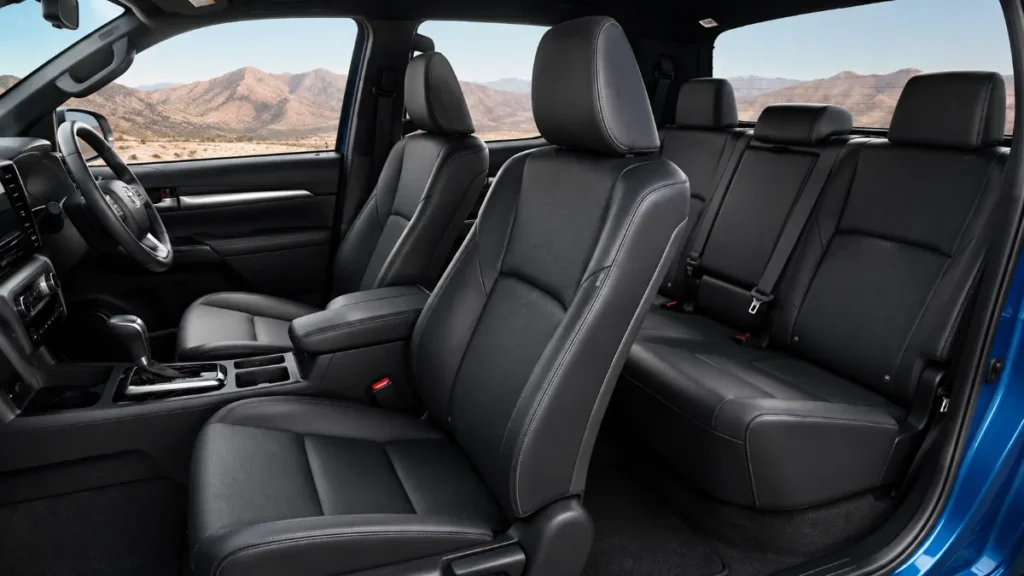
One of the first differences buyers will notice is the seat upholstery.
The global-spec Hilux is available with leatherette surfaces, while the India-spec model uses fabric upholstery in the relevant configuration. Toyota has nevertheless focused on making the Indian cabin more premium, with soft-touch surfaces, metallic accents and a redesigned dashboard.
Fabric seats are not necessarily a disadvantage. They can be more comfortable in extreme temperatures and are generally less prone to becoming extremely hot under direct sunlight. They can also make sense in a vehicle that may regularly be used for outdoor activities.
The downside is cleaning. Mud, dust and stains can be more difficult to remove from fabric than from leatherette.
For a lifestyle pickup costing well above ₹30 lakh, however, some buyers may still expect a more premium seat finish.
2. Electrically Adjustable Front Seats
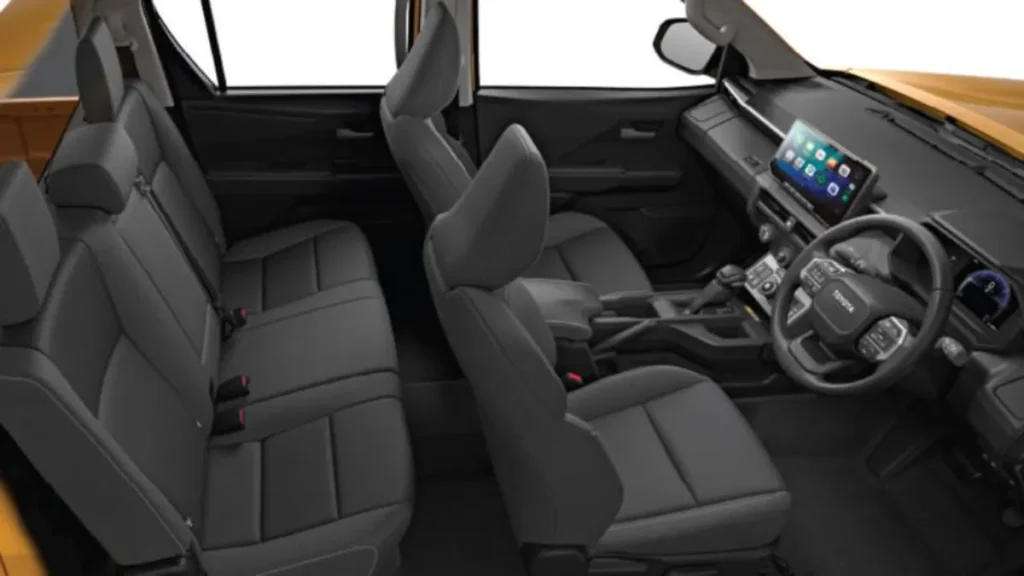
The new Hilux’s cabin is considerably more modern than before, but the India-spec model misses out on the electrically adjustable front seats available in some global versions.
This is one of those features that is primarily about convenience rather than performance.
Power adjustment allows the driver to fine-tune the seating position more easily, particularly when the vehicle is shared between different drivers. It also adds to the premium feel of the cabin.

On the other hand, manual seats have fewer electrical components and are mechanically simpler. For owners who intend to take the Hilux into remote areas, that simplicity may actually be reassuring.
So while powered seats would certainly improve comfort, their absence does not affect the Hilux’s core off-road abilities.
3. 48V Mild-Hybrid Technology
The 48V mild-hybrid system is arguably one of the most interesting features missing from the Indian Hilux.
The technology is offered with the 2.8-litre diesel engine in certain international markets. It uses an electric motor-generator and battery assistance to improve efficiency, refinement and low-speed operation.
The Indian Hilux instead continues with the 2.8-litre diesel producing 204 PS and 500 Nm, paired with a six-speed automatic gearbox.
For everyday driving, a mild-hybrid system could have helped make the pickup smoother and potentially more efficient.
But there is another side to the story.
A conventional diesel powertrain has fewer components than a hybrid-assisted setup. For customers who plan to use their Hilux for long-distance travel, remote exploration, water crossings and demanding off-road conditions, mechanical simplicity can be valuable.
In other words, losing the mild-hybrid system may hurt efficiency, but it could also keep the powertrain relatively straightforward.
4. Electric Power Steering
Another notable difference is the steering system.
The global Hilux has moved to electric power steering in some markets, whereas the India-spec model retains hydraulic power steering.
Electric steering generally makes low-speed manoeuvring easier. That can be particularly useful in cities, parking areas and tight spaces because the steering wheel requires less effort.
Hydraulic steering, however, has a reputation among enthusiasts for delivering a more direct and natural connection with the front wheels.
For a vehicle like the Hilux, which is designed to travel beyond paved roads, that steering feel can be appreciated.
The trade-off is simple: electric steering offers convenience, while hydraulic steering keeps the mechanical character of the pickup intact.
5. Rear Disc Brakes
The India-spec Hilux also misses out on rear disc brakes offered on some global versions.
Instead, the Indian model continues with rear drum brakes. This may look like a strange decision on a premium pickup, particularly when four-wheel disc brakes are increasingly common on modern SUVs and larger vehicles.
Disc brakes generally offer strong and consistent braking performance, especially under repeated heavy braking.
Drum brakes, however, are proven technology and remain widely used on utility vehicles. They can also be robust and relatively straightforward to maintain.
For a Hilux buyer who spends most of their time on highways, rear discs would certainly be a welcome upgrade. But for an owner focused on durability and utility, the difference may not be as important as it appears on paper.
6. Dual-Zone Automatic Climate Control
Perhaps the most noticeable comfort-related omission is automatic climate control.
The global-spec Hilux can be equipped with dual-zone automatic climate control, while the India-spec version uses a manual air-conditioning system.

This is arguably the feature that Indian buyers are most likely to question.
Automatic climate control allows occupants to select a temperature and let the system manage cooling automatically. Dual-zone functionality also allows the driver and front passenger to choose different temperature settings.
The India-spec Hilux instead uses conventional physical controls.
There is an advantage here too: physical controls are simple, easy to understand and can be operated quickly without navigating menus.
Still, considering the Hilux’s price and premium positioning, automatic climate control would have made the cabin feel more upmarket.
The Bigger Picture: Is the India-Spec Hilux Still a Good Package?
Despite these omissions, the 2026 Toyota Hilux has taken a significant step forward.
Toyota has redesigned the exterior, upgraded the cabin and added modern connectivity features. The Indian model gets a 12.3-inch infotainment system with wireless Apple CarPlay and Android Auto, Toyota i-Connect functionality, an eight-speaker audio system and a 7-inch combination meter.
The pickup also retains the qualities that have made the Hilux famous.
Its 2.8-litre diesel engine produces 204 PS and 500 Nm, while 4×4 variants feature high- and low-range gearing, an electronic differential lock and Downhill Assist Control.
Safety equipment includes seven airbags, Vehicle Stability Control, ABS with Brake Assist, parking sensors, TPMS and a panoramic-view monitor.
So, while the missing features are worth discussing, they don’t change the fundamental character of the Hilux.

Why Toyota May Have Kept Things Simpler
There is an interesting argument behind some of these omissions.
The Hilux is not simply a luxury SUV with a pickup bed. Its reputation has been built around durability, reliability and the ability to operate in difficult environments.
Adding more electrical systems, motors and electronic components can improve comfort, but it can also make a vehicle more complex.
For an urban customer, powered seats, electric steering and automatic climate control may be high on the priority list. For someone buying a Hilux for serious off-road adventures, simplicity and proven mechanical hardware may matter more.
That is where the India-spec Hilux could actually make sense.
Final Verdict
The 2026 Toyota Hilux is certainly more modern than its predecessor, but Indian buyers do not get every feature available in international markets.
The biggest omissions include leatherette upholstery, electrically adjustable front seats, 48V mild-hybrid technology, electric power steering, rear disc brakes and dual-zone automatic climate control.
Some of these missing features would have improved comfort and convenience, while others may not be particularly important to someone who values the Hilux primarily for its ruggedness.
Ultimately, the new Hilux continues to focus on what made the nameplate successful in the first place: strong performance, 4×4 capability, durability and mechanical confidence.
For buyers wanting a feature-loaded premium lifestyle pickup, the omissions may be disappointing. But for enthusiasts who see the Hilux as a tough machine rather than a luxury SUV, the simpler India-spec package could actually have its own appeal.